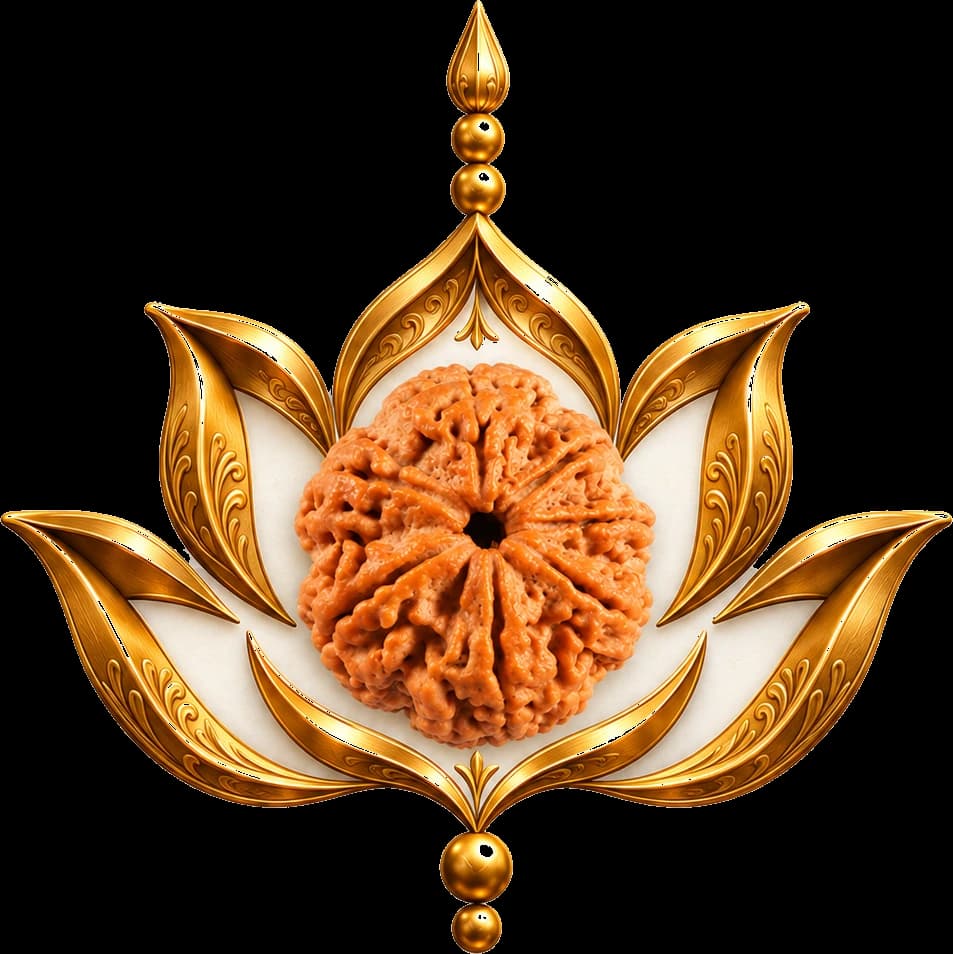
Siddha Mala
Every mukhi, on one thread
A Siddha Mala holds one bead of every mukhi, with Ganesh and Gauri Shankar. Ours are strung from Nepali beads grown, sorted and X-rayed on the farm, and each strand is priced and confirmed bead by bead before you pay.
Every bead X-rayed
A strand is only as good as its weakest bead.
Priced bead by bead
You see each bead and its X-ray before you pay.
From our own trees
Nepali beads grown and sorted on the farm.
16 beads in a basic strand, from 1 to 14 Mukhi with Ganesh and Gauri Shankar.
The range
Six strands, one standard
Two are defined by how far up the mukhi they run; four are strung for a purpose. Every one is built from this season’s beads and quoted with its full contents.
The complete classical range
Siddha Mala (Basic)
1–14 Mukhi · Ganesh · Gauri Shankar
16 beads
One bead of every mukhi from 1 to 14, with Ganesh and Gauri Shankar.
The fuller range, to 21 Mukhi
Sarva Siddha Mala
1–21 Mukhi · Ganesh · Gauri Shankar
23 beads
The fuller range, one bead of every mukhi from 1 to 21, with Ganesh and Gauri Shankar.
Strung for a purpose
Each strand’s beads are confirmed when we quote.
Work and undertakings
Karya Siddha Mala
A Siddha Mala strung for success in work and undertakings.
Ask about this strandGayatri sadhana and japa
Gayatri Siddha Mala
A Siddha Mala strung for Gayatri sadhana and japa.
Ask about this strandThe Maha Mrityunjaya mantra
Maha Mrityunjaya Siddha Mala
A Siddha Mala strung for the Maha Mrityunjaya mantra, for health and protection.
Ask about this strandFor collectors
Brahma Siddha Mala
The collector’s Siddha Mala, with the higher mukhi beads in the strand.
Higher mukhi beads
Ask about this strand
On the thread
The beads in a basic Siddha Mala
Every bead on the strand has its own page, with what it is traditionally worn for and the sizes we grow it in. Tap one to read about it.
- 1 MukhiLord Shiva / Sadashiva
- 2 MukhiArdhanarishvara (Shiva-Shakti)
- 3 MukhiAgni Dev
- 4 MukhiLord Brahma
- 5 MukhiKalagni Rudra
- 6 MukhiLord Kartikeya
- 7 MukhiGoddess Mahalakshmi
- 8 MukhiLord Ganesha
- 9 MukhiGoddess Durga
- 10 MukhiLord Vishnu
- 11 MukhiEkadasha Rudra (Hanuman)
- 12 MukhiLord Surya (Aditya)
- 13 MukhiKamadeva / Indra
- 14 MukhiHanuman / Devamani
- Ganesh RudrakshaLord Ganesha
- Gauri ShankarShiva-Parvati (conjoined)
The 1 Mukhi on our strands is the Nepali half-moon (Kaju) form, the one that grows on our trees. The Sarva Siddha Mala carries the same thread on to 21 Mukhi.
Why a whole range
What a Siddha Mala is
Most people wear one Rudraksha, chosen for one purpose. A Siddha Mala takes the other route: it strings one bead of every mukhi in a range on a single thread, so the wearer carries every presiding deity, planet and chakra the beads are traditionally linked with. The Ganesh Rudraksha is added for a clear start, and the Gauri Shankar for harmony at home.
A Siddha Mala is only as good as its weakest bead.
A single glued, carved or mislabelled bead in the middle of a strand is easy to miss, which is why every bead in it is X-rayed like every other bead we sell.
Made to order
How we put one together
If a bead in your range is not available this season, we say so rather than fill the gap with a bead from elsewhere, and you decide whether to wait for it.
Start with a message- 01
Tell us which strand
Message us with the Siddha Mala you are after, and a bead size if you have one in mind.
- 02
We check the harvest
We do not keep strands made up and waiting. We look at what this season has given us.
- 03
You get the list
Each bead, its size in millimetres and its X-ray, with one price for the whole strand.
- 04
Approve, then pay
Only once you are happy with every bead is the strand put together and sent.
Questions
Common questions
Not sure which strand suits you, or want a size we have not listed? Ask, and we will tell you what this season’s harvest can make.
Ask us directlyWhat is a Siddha Mala?
A Siddha Mala is a single strand holding one Rudraksha of every mukhi in a range, usually 1 to 14 Mukhi, together with a Ganesh Rudraksha and a Gauri Shankar. It is worn so that every bead’s traditional association is carried at once, rather than choosing one.
What is the difference between a Siddha Mala and a Sarva Siddha Mala?
The range. The basic Siddha Mala runs from 1 to 14 Mukhi; the Sarva Siddha Mala carries on to 21 Mukhi. The higher beads are much rarer, which is why a Sarva Siddha Mala costs many times more than a basic one.
Why is a Siddha Mala priced on request?
Because it depends on the season. Each strand is assembled from that harvest’s beads, and the higher mukhi are not available in every size every year. When we quote, we list exactly which beads are in your strand, with each one’s X-ray.
Which 1 Mukhi goes into your Siddha Mala?
The Nepali half-moon (Kaju) 1 Mukhi, which is the form that grows on our trees. A round 1 Mukhi from Nepal is a claim we would treat with suspicion, and we do not sell one.
How is a Siddha Mala worn?
Traditionally around the neck, on a day chosen with a priest or on a Monday, after the beads have been cleaned and the mantra of each, or Om Namah Shivaya for the whole strand, has been chanted. Many people keep it on a shrine and wear it for puja only.
These are traditional associations recorded in Vedic and Puranic sources. They are described here as tradition, not as medical or therapeutic claims, and no bead is a substitute for medical care.